
Uploadarticle: Complete Guide to Smarter Article Publishing and Guest Post Evaluation
Uploadarticle is commonly associated with online article publishing, contributor submissions, guest posting, and content discovery. The name appears across several independently operated publishing websites, which means writers should verify the exact domain before creating an account, submitting content, or negotiating placement terms.
For bloggers, businesses, freelance writers, and SEO teams, the practical value is straightforward: publish useful material outside an owned website and reach readers through an established publishing environment.
The opportunity still requires due diligence. Editorial requirements, accepted subjects, account access, links, images, and submission methods can differ substantially between sites using similar branding.
What Is Uploadarticle?
Uploadarticle generally describes an online publishing model where writers or businesses contribute informational articles to a third-party website rather than publishing everything on their own domain.
Current sites using this or closely related branding cover subjects including technology, business, education, health, travel, lifestyle, finance, fashion, home improvement, and SEO. Some accept contributor pitches through editorial review, while others position themselves more directly around guest posting.
Basic Publishing Flow
Identify exact domain → Check editorial rules → Choose suitable topic → Prepare original article → Submit for review → Handle requested revisions → Receive publication URL → Measure results
That sequence separates professional content distribution from simply placing a link on another website.
Why Is Uploadarticle Important?
Uploadarticle can serve several legitimate publishing objectives when the destination site and article are selected carefully.
- Audience expansion: A contributor can reach readers who may never visit the writer’s own website.
- Subject authority: Detailed articles provide room to demonstrate practical knowledge instead of relying on short promotional copy.
- Brand discovery: Readers can encounter a company, author, product, or idea during research rather than through direct advertising.
- Referral opportunities: Contextual references can send interested visitors toward additional resources.
- Portfolio development: Freelancers can build a public record of work across multiple editorial environments.
- Content distribution: Strong research can gain additional exposure without republishing an identical article everywhere.
- Relationship building: Consistently useful contributions can create longer-term publisher and contributor relationships.
Third-party publishing is not automatically an SEO shortcut. Google classifies links created primarily to manipulate rankings as link spam and specifically addresses paid links, optimized guest-post anchors, and low-value content produced mainly for ranking purposes.
Quick Reference Matrix
| Core Element | Action / What it Involves | Primary Goal / Output |
|---|---|---|
| Domain identity | Confirm the exact website and operator | Avoid brand confusion |
| Editorial scope | Inspect categories and recent posts | Establish subject compatibility |
| Contributor policy | Read current submission requirements | Prevent avoidable rejection |
| Originality | Produce unique material | Give readers independent value |
| Author identity | Use accurate contributor details | Establish accountability |
| Supporting media | Supply suitable visual assets when required | Improve presentation |
| Link treatment | Understand editorial and commercial rules | Reduce compliance risk |
| Publication record | Save the final live URL and date | Maintain campaign documentation |
How to Use Uploadarticle for Content Publishing
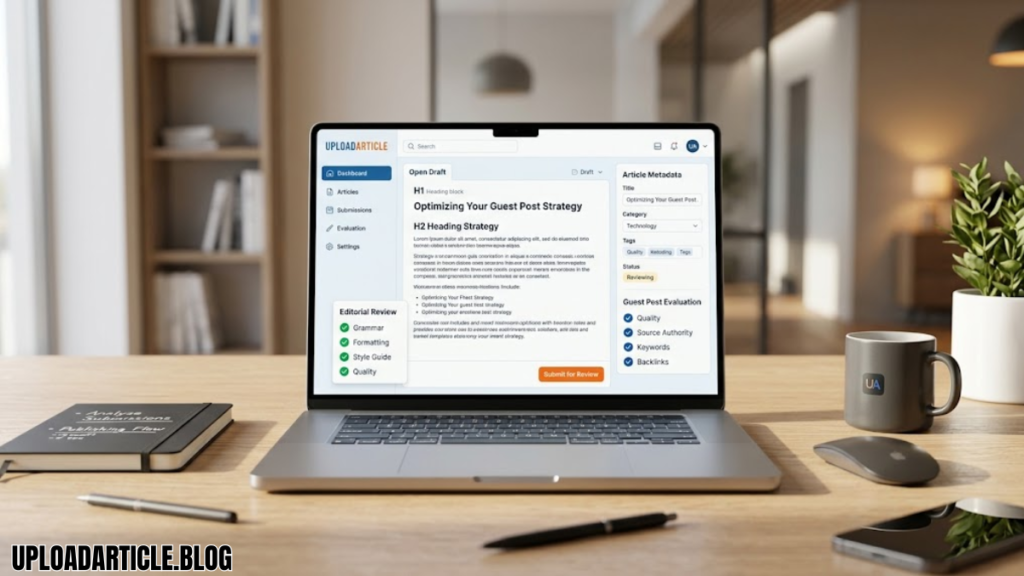
A professional submission starts before the article is written. The biggest time savings come from qualifying the publication first, then producing content specifically for its readers.
Step 1: Confirm the Exact Website
Similar names are currently used by multiple independent websites. One publishing site even states directly that its identity should not be confused with other similarly named domains.
Before communicating with an editor:
- Check the full domain, including its extension.
- Open the About, Contact, Privacy, and contributor pages.
- Compare branding between those pages.
- Inspect several recently published articles.
- Confirm that contact addresses belong to the expected website.
- Record the URL in your publishing spreadsheet.
Never rely only on a brand name copied from an outreach email.
Step 2: Read the Live Contributor Requirements
Submission rules can change.
Current similarly named publishing properties demonstrate how large those differences can be. One says contributors do not need a public self-service account, another requests articles above 800 words, while a different site states 1,200 words plus two relevant images in its contributor guidance.
Create a requirement sheet before drafting:
| Requirement | What to Record |
|---|---|
| Minimum length | Exact current word requirement |
| Categories | Accepted subject areas |
| Images | Quantity, size, ownership rules |
| Links | Number and permitted destinations |
| Bio | Author-name and profile requirements |
| Formatting | Heading, paragraph, and file preferences |
| Submission route | Form, email, dashboard, or pitch |
| Review policy | Editing or rejection conditions |
A five-minute policy check can prevent a full rewrite later.
Step 3: Match the Topic to Real Reader Intent
Skip broad titles such as “Everything About Digital Marketing.” Narrow subjects normally create a clearer editorial purpose.
A useful topic should answer one identifiable need:
- Problem solving: Explain how to fix a specific issue.
- Decision support: Compare practical alternatives.
- Process guidance: Walk readers through a task.
- Research interpretation: Explain what data means.
- Experience transfer: Share lessons from a real workflow.
Review the publication’s existing archive before selecting the angle. Avoid producing another version of an article it published recently.
Step 4: Build a Submission-Ready Article
Editors should not need to reconstruct the article after receiving it.
Package the draft with:
- One descriptive H1
- A concise opening that establishes the subject immediately
- Logical H2 and H3 sections
- Short paragraphs
- Original examples
- Verified factual statements
- Descriptive image filenames
- Image-source information where applicable
- A clean author bio
- Suggested metadata if accepted by the publisher
Remove internal notes, highlighted instructions, unused links, and drafting comments before delivery.
Step 5: Handle Links Carefully
A useful citation and a ranking-driven link are not the same thing.
Google’s current spam documentation says buying or selling links for ranking purposes can constitute link spam. It also says paid advertising links can be handled with rel="nofollow" or rel="sponsored" rather than passing ranking credit.
For each outbound link, ask:
- Does the destination genuinely help the reader?
- Does the anchor describe what is behind the link?
- Would the reference still make sense without SEO benefit?
- Is payment or another commercial arrangement involved?
- Does the publisher have a documented link policy?
Natural editorial references are easier to defend than forced keyword anchors.
Step 6: Submit Through the Approved Channel
Use the publisher’s documented method.
A clean submission email or form entry should contain the proposed title, short topic summary, contributor identity, article document, and required images. Extra sales language rarely helps an editor evaluate the draft.
Track four dates internally:
| Status | Date to Record |
|---|---|
| Submitted | Initial delivery |
| Editor replied | First response |
| Revision delivered | Updated copy |
| Published | Live-page date |
This matters when several writers or client campaigns run simultaneously.
Step 7: Audit the Published Page
Do not end the workflow when an editor says the article is live.
Open the page and inspect the actual output:
- Check the title and author name.
- Test every intentional URL.
- Inspect the page on mobile.
- Confirm images load properly.
- Look for accidental paragraph or heading errors.
- Save the live URL.
- Archive the approved final draft.
Report factual or formatting errors quickly while the publication is still fresh.
Industry and Use-Case Specific Scenarios
Freelance Writers Building Credibility
A writer can use external publications to demonstrate experience in specific industries rather than presenting only private samples.
For example, a cybersecurity writer can build a stronger portfolio through articles about password management, phishing prevention, cloud permissions, and security operations instead of relying on a generic “technology writer” claim.
Digital PR Teams
PR teams can use educational articles to provide background material around an expert, research project, survey, or company development.
The editorial angle should stand independently from the company announcement. A reader should gain something even without becoming a customer.
Subject-Matter Experts
Accountants, developers, architects, marketers, analysts, and consultants often possess useful knowledge that never becomes publishable material.
A structured contributor platform gives that expertise a searchable public format without requiring the expert to operate a media website.
Publishers Looking for Contributors
The model works from the opposite direction too.
A publisher can accept external expertise to cover technical topics its internal team cannot address efficiently. Strong editorial screening becomes the value layer: topic selection, fact checking, formatting consistency, authorship, and quality control.
Agencies Managing Multiple Campaigns
Agencies need operational control more than individual contributors do.
A database can separate domain, niche, editor, turnaround history, client, article title, publication URL, invoice reference, and live-status information. That reduces mistakes when dozens of placements are active at once.
Third-Party Publishing vs Publishing on Your Own Website
| Factor | Third-Party Publication | Owned Website |
|---|---|---|
| Editorial control | Publisher decides | Site owner decides |
| Audience ownership | Limited | Direct |
| Content lifespan control | Publisher-dependent | Owner-managed |
| Design flexibility | Restricted | Extensive |
| First-party analytics | Often unavailable | Normally available |
| Conversion paths | Usually limited | Fully customizable |
| Brand environment | Shared | Exclusive |
| Updating old material | Permission may be required | Immediate access |
| Monetization | Publisher-controlled | Owner-controlled |
| Platform dependency | Higher | Lower |
Neither approach replaces the other. Owned publishing builds an asset; external publishing extends distribution.
Common Mistakes & Best Practices
Common Mistakes to Avoid
- Submitting the same article to several domains. Duplicate distribution reduces editorial value and can create ownership disputes.
- Using exact-match anchors repeatedly. Mechanical anchor patterns make an otherwise useful article look engineered for links.
- Ignoring the publication’s recent history. An active homepage does not prove every section is maintained equally.
- Using stock claims without evidence. Unsupported statistics weaken the entire draft.
- Hiding commercial relationships. Advertising arrangements should follow the publisher’s disclosures and applicable rules.
- Sending copyrighted images without permission. Publication rights must cover the supplied visual.
- Writing an advertisement disguised as a tutorial. Editors and readers can recognize product-first copy quickly.
- Losing the approved version. Keep the exact submitted and published copies for future reference.
How to Maximize Efficiency / Best Practices
- Create niche-specific author bios rather than one generic biography.
- Give every campaign a unique internal reference ID.
- Use UTM parameters when a publisher permits them and referral measurement matters.
- Maintain a source log for statistics, quotes, studies, and factual claims.
- Name image files descriptively before submission.
- Keep original visual licenses or creation records.
- Record editorial contacts separately from billing contacts.
- Review external placements periodically for broken destination pages.
- Maintain consistent spelling of the author or brand name across publications.
- Keep sensitive client credentials out of shared article documents.
Future and Modern Trends
The future of Uploadarticle-style publishing is moving toward stricter editorial differentiation rather than unrestricted article volume.
Google’s current spam rules target scaled low-value content regardless of whether automation, AI, scraping, or another production method created it. Mass publication alone is not a quality signal.
Site reputation abuse also deserves more attention from publishers and SEO teams. Google updated its policy in August 2026 and continues to target third-party material hosted primarily to exploit an established site’s ranking signals; editorial third-party content itself is not automatically a violation.
That creates several visible shifts:
- Stronger author identification
- Better separation between editorial and commercial content
- Increased screening of unrelated third-party topics
- More attention to source quality
- Greater demand for original experience and evidence
- Tighter controls around programmatic publishing
- More scrutiny of content networks built mainly for search visibility
AI will remain useful for research organization, transcription, editing, and workflow support. Publishing value will depend on what the finished article contributes, not which drafting tool touched it.
Practical Publishing Checklist
Use this before approving an external article campaign.
- The exact domain has been confirmed.
- Ownership and contact information appear consistent.
- Recent posts show active editorial maintenance.
- The topic fits a visible section of the publication.
- The manuscript has a clearly identified author.
- Statistics trace back to credible sources.
- Every image has valid usage rights.
- Commercial relationships are documented.
- The final article has been proofread manually.
- Destination pages work before submission.
- Publication terms have been saved internally.
- The final live version can be audited later.
Final Thoughts
Uploadarticle works best when treated as a publishing opportunity rather than a shortcut for placing links. The strongest contribution gives a publication something its readers genuinely need: original knowledge, clear explanations, useful evidence, or practical experience.
Verify the exact website first. Then judge the opportunity on editorial fit, transparency, content quality, audience relevance, and long-term publishing value rather than a domain name alone.
Frequently Asked Questions – FAQs
Is Uploadarticle One Single Website?
Not necessarily. Multiple independently operated domains currently use UploadArticle or closely related branding, so the exact URL matters. One current site explicitly states that it should not imply affiliation with similarly named domains without documentation.
Do I Need an Account to Submit an Article?
That depends on the specific website. One current publishing property states that writers do not need to create a public account before proposing or submitting material, because submissions pass through editorial review instead.
How Long Should a Guest Article Be?
There is no universal length. Current sites using similar branding publish different contributor requirements, including 800+ words on one site and 1,200+ words on another, which is why the live guidelines should be checked immediately before drafting.
Can AI-Written Articles Rank in Google?
Google’s published policy focuses on scaled content created primarily to manipulate rankings, not simply on whether AI participated in production. Large amounts of unoriginal or low-value material can violate spam policies regardless of how it was generated.
Are Paid Guest-Post Links Safe for SEO?
Payment itself is not automatically prohibited, but Google says paid links intended to pass ranking credit can constitute link spam. Its documentation recommends qualifying advertising or sponsored links appropriately, including through nofollow or sponsored attributes.
Should I Publish the Same Article on Multiple Websites?
A better editorial strategy is to create distinct material for each publication. Reusing an identical manuscript limits the unique value each publisher receives and can also create uncertainty around exclusivity or future content rights.
How Do I Know Whether an Article Platform Is Worth Using?
Look beyond surface metrics. Examine recent publishing activity, topical consistency, author transparency, editorial standards, real readership relevance, website usability, and the quality of existing articles before committing resources.